 APIs (2)
 Bulk SMS (19)
 Click to Call (4)
 Cloud Call Center (14)
 WhatsApp Business API (3)
 Cloud Telephony (23)
 DLT (4)
 IVR (5)
 Missed Call (3)
 Mobile Cloud Call Center (2)
 Outbound Calling Service (3)
 Political Campaigns (15)
 Toll Free Number (5)
 Voice Broadcasting Service (15)
 Zoho CRM (1) WhatsApp (32)
 RCS SMS(5)
 LMS(2)
 140 and 1600 Series(8)
 Omnichannel(3)
 AI Solutions(3) APIs (2) Bulk SMS (19) Click to Call (4) Cloud Call Center (14) Whats AppBusiness API (3) Cloud Telephony (23) DLT (4) IVR (5) Missed Call (3) Mobile Cloud Call Center (2) Outbound Calling Service (3) Political Campaigns (15) Toll Free Number (5) Voice Broadcasting Service (15) Zoho CRM (1) WhatsApp (32) RCS SMS(5) LMS(2) 140 and 1600 Series(8) Omnichannel(3) AI Solutions(3)
Nov
Businesses handle thousands of customer conversations every day, from following up with potential customers and sending payment reminders to confirming appointments and collecting feedback.
Managing these repetitive interactions manually requires significant time, manpower and resources. This is where AI voice agents are transforming business communication.
Unlike traditional IVR systems that rely on predefined menus, AI voice agents use conversational AI, speech recognition and Natural Language Processing (NLP) to understand spoken responses, identify customer intent and respond contextually. They can ask relevant follow-up questions, maintain conversational continuity and automate predefined workflows.
However, every business has different communication requirements. While a real estate company may need AI to qualify property leads, a bank may use it for EMI reminders and a hospital may automate appointment confirmations.
So, how do you choose the right AI voice agent for your business? Read this go2market blog to understand AI capabilities that matter most to your business operations.
AI voice agents can support lead generation, customer engagement, service delivery and feedback collection. Here are some practical industry applications.
1. Real Estate: Lead Qualification and Requirement Collection
Real estate companies receive multiple property enquiries but often struggle with timely follow-ups.
AI voice agents can:
Business benefit: Faster lead qualification and better sales team productivity.
2. BFSI: EMI Reminders and Payment Follow-ups
Banks and NBFCs manage large customer databases and recurring payment schedules. AI can automate routine payment-related communication.
Use cases include:
Business benefit: Consistent customer communication and reduced manual calling efforts.
3. Healthcare: Patient Appointment Confirmations
Hospitals, clinics and diagnostic centres can use AI voice agents to manage appointments.
AI can:
Business benefit: Fewer missed appointments and reduced administrative workload.
4. EdTech: Student and Parent Communication
Educational institutions and EdTech companies regularly communicate with students and parents regarding tests, attendance and academic performance.
AI voice agents can:
Business benefit: Timely communication and improved parent engagement.
5. Politics and Governance: Turning Citizen Conversations into Actionable Insights
Political parties, leaders, elected representatives and government departments need to understand public concerns, assess welfare scheme implementation and gather citizen feedback.
AI voice agents help political campaigns with two-way citizen communication, moving beyond one-way announcements to structured feedback collection.
Applications include:
For example, an AI voice agent can call citizens, ask about their satisfaction with local development work, identify their most pressing concerns and record responses for further analysis.
Business benefit: Large-scale citizen engagement, structured public feedback and better understanding of constituency-level issues.
6. Retail and E-commerce: Customer Engagement & Feedback
Retailers and e-commerce businesses can automate post-purchase communication and customer feedback collection.
AI voice agents can:
Business benefit: Improved customer experience, faster feedback collection and better customer retention.
Before selecting a solution, evaluate whether it meets your operational requirements.
Traditional IVR systems operate through predefined menus, requiring callers to listen to options and select the appropriate response.
AI voice agents offer a more natural interaction. Customers can explain their requirements in their own words, while the AI understands intent, asks relevant questions and responds according to the conversation context.
This makes conversational AI particularly useful for high-volume calling, repetitive interactions and information-collection workflows.
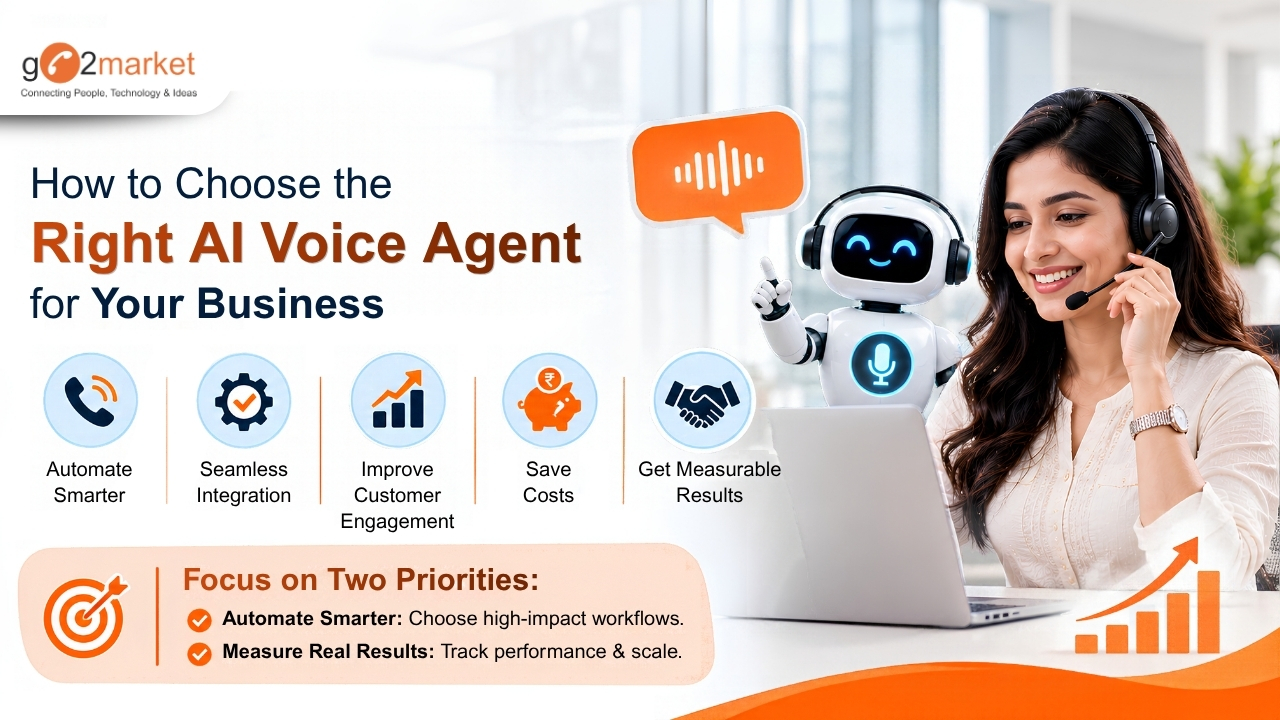
AI voice agents deliver the greatest value when applied to the right business use cases. Start with repetitive, high-volume calling workflows, measure results and gradually scale automation across your operations.
The right solution should complement your existing infrastructure, streamline communication, save costs and improve customer experiences, not simply add more technology.
Focus on two priorities:
Ready to transform business communication? Explore Go2Market's AI Voice Agent and Survey Solution to automate large-scale calling, capture customer insights and turn conversations into actionable business intelligence.
Frequently Asked Questions (FAQs)
1. What is an AI voice agent?
An AI voice agent is a conversational AI system that understands spoken language and responds naturally to automate customer interactions over phone calls.
2. How is an AI voice agent different from an IVR?
Traditional IVRs use predefined menus, while AI voice agents understand natural speech, customer intent and conversational context.
3. Can AI voice agents support multiple languages?
Yes. Depending on the platform, AI voice agents can support multiple languages and regional language preferences.
4. Can AI voice agents integrate with CRM systems?
Yes. Through APIs and integrations, they can update customer records, capture responses and trigger follow-up workflows.
5. Which industries can benefit from AI voice agents?
Real estate, BFSI, healthcare, education, retail, political organizations and government departments can use AI voice agents for customer communication, reminders, lead qualification and feedback collection.
Follow Us